
Key Takeaways About UK Energy Bills That Will Help You Understand The Current Situation:
- The Iran conflict is directly affecting your energy bills right now. Wholesale gas prices are rising and further bill increases are widely expected.
- Most UK homes waste a significant amount of the energy they pay for. Heat escaping through roofs, walls and windows costs you daily.
- Fabric first is always the smartest and most cost effective starting point. Loft insulation and draught proofing deliver immediate, measurable savings quickly.
- Government grants can significantly reduce your home upgrade costs. ECO4, Great British Insulation Scheme and Boiler Upgrade Scheme are worth checking immediately.
- Getting the sequence and specification right is where most homeowners struggle. Book a consultation with Gordon Evans at YOOP Architects today.
UK energy bills are rising again, and this time, a conflict thousands of miles away is partly to blame. If you opened your latest energy statement and felt that familiar sinking feeling, you are not imagining it.
Global gas prices have been climbing since tensions escalated in Iran, and because Britain still depends heavily on imported gas, those price shocks travel straight into our homes. Fast.
It does not feel fair. You cannot control what happens in the Middle East.
But here is something worth knowing: most UK homes waste a staggering amount of the energy they pay for.
Heat leaking through old roofs, draughty window frames, uninsulated walls. That is money disappearing before it even warms the room.
The good news?
Architect-led home upgrades can change that. And they can do it faster than most people expect.
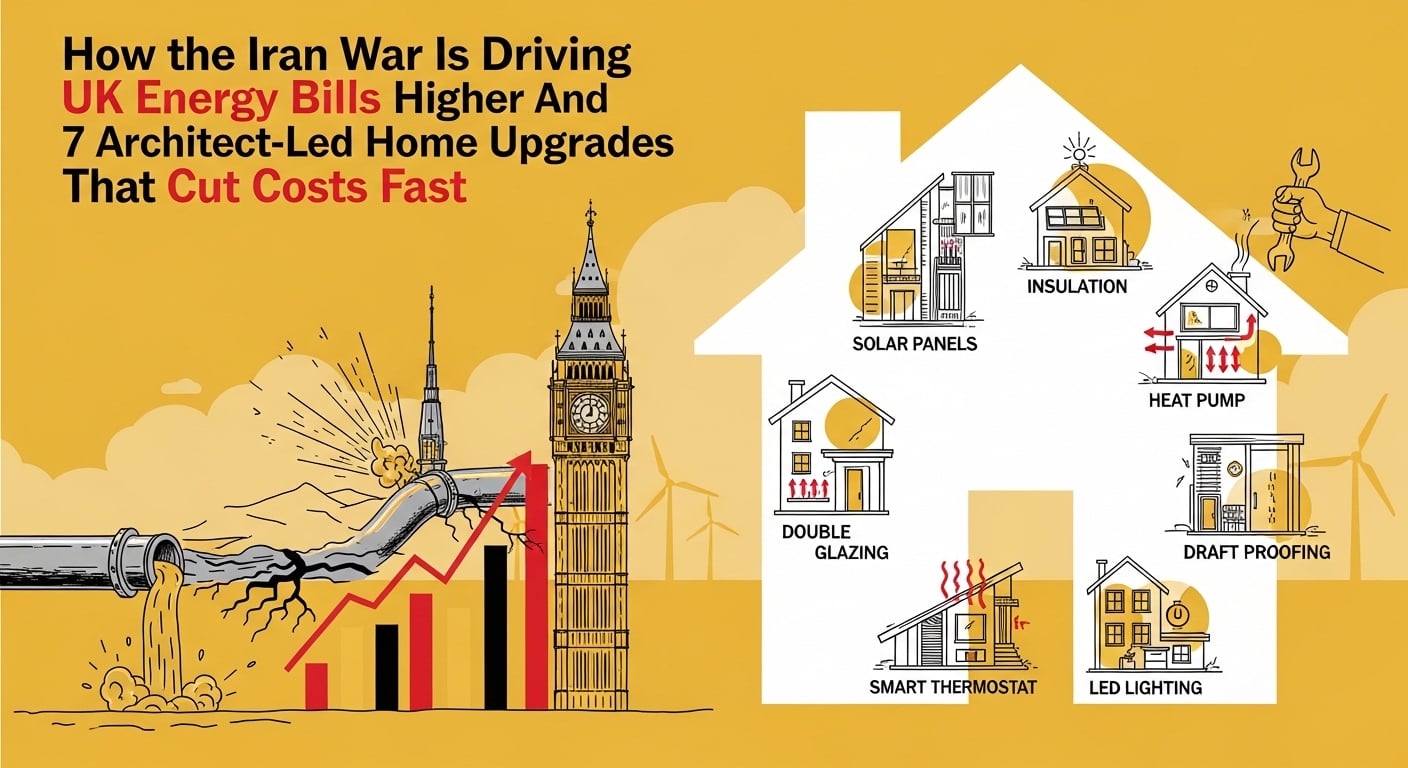
In this article, we will discuss how the Iran conflict is pushing your bills up and reveal seven (7) practical, architect-designed upgrades that cut energy costs quickly and keep your home warmer for years to come.
To get started, book a personalised consultation with Gordon Evans at YOOP Architects online today.
How the Iran War Is Driving UK Energy Bills Higher
Britain imports a significant chunk of its gas.
So when global supply gets unsettled, your household bills feel it almost straight away. That is just how the market works, unfortunately.
Here is what has been happening since the Iran conflict escalated:
- Wholesale gas prices have spiked sharply. Traders reacted quickly, pushing futures prices up steeply across European markets.
- The 2022 energy crisis left markets on edge. Suppliers and traders have been cautious ever since, so any fresh global shock hits prices harder and faster than it once did.
- The UK price cap offers only limited protection. It adjusts every quarter, meaning rising wholesale costs eventually land directly on your bill.
What This Could Mean for Your Bill in the Next 6 to 12 Months
| Timeframe | What to Expect |
|---|---|
| Right now | Bills already sitting well above pre-crisis levels |
| 3 to 6 months | Further price cap rises likely if wholesale prices stay high |
| 6 to 12 months | Sustained high bills if the Iran conflict keeps disrupting supply routes |
The pattern is pretty clear. Global events move quickly. The best defence you have is making your home as energy efficient as possible.
7 Smart Home Upgrades That Cut Energy Costs Fast

With bills climbing again, the smartest move is making your home work smarter for you.
Here are seven (7) upgrades that deliver real results, fast:
- Loft and Roof Insulation (Fastest Fabric Win)
Up to 25% of your home’s heat escapes through the roof. Topping up loft insulation to the current recommended depth of 270mm is still one of the fastest payback improvements available in 2026.
- Heat loss through the roof is significant and entirely preventable.
An under-insulated roof is essentially leaving your heating running with a window wide open every single day of winter. - The ECO4 scheme can fund loft insulation for eligible households.
If your home is EPC rated D to G and you meet income criteria, you may qualify for fully funded installation through your energy supplier. - Savings are immediate and measurable.
A typical semi-detached home can save between £150 and £250 annually, with installation costs often recovered within two to three years.
2. Cavity Wall and Internal/External Wall Insulation
Walls account for around 35% of heat loss in an uninsulated home.
Choosing the right insulation system for your wall type makes an enormous difference to both comfort and running costs.
- Cavity wall insulation suits most post-1920s homes and is relatively affordable.
Costs typically range from £500 to £1,500, and the improvement to EPC D and E rated properties is noticeable almost immediately.
- Solid wall homes built before 1920 need a different approach entirely.
External wall insulation is the most effective option, though internal insulation works well where external changes are restricted by planning rules. - The Great British Insulation Scheme supports wall insulation for lower EPC homes.
Eligible households can access funded or subsidised insulation, significantly reducing the upfront cost of this important upgrade.
3. Draught Proofing and Airtightness Details
Draughts are silent bill-killers. Gaps around doors, windows, floorboards and loft hatches can account for up to 20% of heat loss in older UK properties.
The fix is often surprisingly simple and affordable.
- Sealing gaps is one of the cheapest and most immediate wins available.
Basic draught proofing materials cost very little, and most homeowners notice the difference in warmth and comfort almost straight away. - Building Regulations Part L sets minimum airtightness standards for new builds and major renovations.
If you are planning significant works, your project will need to meet these standards, making draught proofing a regulatory requirement as well as a financial one.
- Better airtightness means your heating system works less hard to maintain comfort.
During price spikes particularly, this translates directly into lower monthly bills without any change to your lifestyle or habits.
4. High Performance Windows and Secondary Glazing
Single glazed and older double glazed windows are significant sources of heat loss.
Upgrading glazing remains one of the most impactful improvements for draughty, cold UK homes, particularly in urban areas with noise pollution concerns.
- Modern A-rated double or triple glazing dramatically reduces heat loss through glass.
Current Building Regulations require replacement windows to achieve a minimum U-value of 1.4 W/m²K, ensuring meaningful thermal performance improvements. - Secondary glazing is a smart, cost-effective alternative for period and listed properties.
It avoids the need for planning permission in many conservation areas and can perform comparably to full window replacement at a lower cost. - The Warm Homes Plan, currently being rolled out in 2026, includes funding support for glazing upgrades.
Eligible low-income households in England can access grants specifically designed to cover improvements like window replacement and secondary glazing installation.
5. Smarter Heating Controls and Zoning
You do not need a full renovation to start saving money on heating.
Smarter controls and zoning are low-disruption changes that can reduce heating bills by up to 30% with minimal upheaval to daily life.
- Smart thermostats and thermostatic radiator valves put you in genuine control of your heating. Devices like Hive, Tado and Google Nest learn your patterns and automatically stop heating rooms that are empty throughout the day.
- Zoning your heating separates living areas from sleeping areas for meaningful savings.
A typical 3-bed semi can cut heating costs noticeably by warming the lounge in the evening and bedrooms only when actually needed.
- The UK government’s Energy Company Obligation requires suppliers to support heating control upgrades for vulnerable households.
If you or someone in your home is on certain benefits, you may qualify for free or subsidised smart heating controls through your energy supplier.
6. Heat Pumps with the Boiler Upgrade Scheme
Gas boilers are becoming less financially viable and increasingly subject to tighter regulation..
Air source heat pumps are now the most popular low-carbon heating choice in the UK, and the Boiler Upgrade Scheme makes switching considerably more affordable in 2026.
- Air source heat pumps extract heat from outdoor air and use significantly less energy than gas boilers.
Even in cold UK winters, modern units operate efficiently and can cut heating bills substantially when installed in a well-insulated home. - The Boiler Upgrade Scheme currently offers up to £7,500 off the cost of an air source heat pump.
This grant, available in England and Wales, has made switching genuinely accessible for many homeowners who previously could not justify the upfront cost. - From 2025, Building Regulations have tightened requirements around new heating installations.
New gas boilers are under increasing regulatory pressure, making heat pumps not just a financially smart choice but an increasingly future-proof one as well.
[Read: UK Heat Pump Grants 2026£7,500 Subsidy Extended Plus New £2,500 Funding – What Homeowners Need to Know]
7. Solar PV and Future Ready Roofs
Rooftop solar is no longer a niche or luxury choice.
In 2026, solar PV is a mainstream, financially sensible upgrade that reduces reliance on grid electricity and offers meaningful protection against future energy price spikes.
- A well-positioned solar PV system can generate enough electricity to significantly offset your annual energy bills.
Even modest systems on east or west-facing roofs generate meaningful output across a typical UK year, which surprises many homeowners. - The Smart Export Guarantee allows you to earn money by selling surplus electricity back to the grid.
Energy suppliers are legally required to offer export payments, turning your roof into a small but genuine source of income. - Pairing solar PV with battery storage and EV charging creates a genuinely resilient home energy system.
Planning for battery storage from the outset, rather than retrofitting it later, saves considerable cost and disruption down the line.
These upgrades deliver real results, but getting the sequence, specification and permissions right is where most homeowners struggle.
A specialist residential architect like Gordon Evans at YOOP Architects ensures every improvement works together as a coherent whole-house strategy, saving you money, stress and costly mistakes.
Prioritising: What To Do First If You Are Worried About Bills
Nobody wants to spend thousands overnight.
The good news is you do not have to.
Start small, build momentum and let each improvement lead naturally to the next.
Here is a simple and practical 5 step roadmap built around real UK homeowner budgets and priorities:
1: Sort the Basics This Weekend
- Draught proof your doors, windows, floorboards and loft hatch right away. Materials from any DIY store cost very little and the difference in warmth is felt almost immediately.
- Turn your thermostat down by just one degree. Most households genuinely cannot feel the difference in comfort but can save around £100 annually without any effort at all.
2: Upgrade Your Heating Controls
- Install a smart thermostat and check every thermostatic radiator valve in your home. Devices like Hive and Tado are widely available, affordable and can cut heating bills by up to 30% quickly.
- Stop heating rooms you are not using regularly throughout the day. This sounds obvious but most UK households heat their entire home unnecessarily for far longer than they actually need to.
3: Tackle Insulation This Season (Check Grant Eligibility First)
- Top up loft insulation to the recommended 270mm before doing anything else structurally.
Always check ECO4 and Great British Insulation Scheme eligibility before spending any of your own money on this.
- Get a current EPC assessment to identify exactly where your home is losing heat.
This gives you a clear, evidence-based priority list rather than guessing where to spend your improvement budget.
4: Plan Wall and Window Upgrades This Year
- Address wall insulation once your loft and draught proofing works are complete and settled.
Cavity wall insulation suits most post-1920s homes while solid wall properties need specialist advice before committing to anything. - Consider secondary glazing before committing to full window replacement, especially in older properties.
It is significantly cheaper, often avoids planning permission complications and performs surprisingly well thermally in most situations.
5: Go Big Within 3 to 5 Years (Strategic and Future Proof)
- Plan your heat pump installation once all fabric improvements are properly in place first.
This sequencing maximises efficiency, reduces running costs and ensures you get full value from the Boiler Upgrade Scheme grant. - Add rooftop solar PV with battery storage as your final layer of genuine energy resilience.
This combination protects you long term against whatever global conflict or market shock pushes energy prices up next.
How to Brief Your Architect for an Energy Saving Renovation
Walking into an architect’s office without preparation is like visiting a doctor without describing your symptoms.
The more context you bring, the better the advice you get. Being clear about your energy goals from the very first conversation saves time, money and frustration later.
Bring these with you to your first consultation, whether in person or online:
- Your most recent EPC report
- Six to twelve months of past energy bills
- Photos of problem areas like cold walls, condensation and draughty windows
- Any existing survey reports or structural assessments
- A rough budget range and timeline for the works
And ask these essential questions:
- What EPC rating can realistically be achieved for my specific property?
- Which improvements will deliver the fastest payback on my investment?
- Can works be phased sensibly around my budget and family life?
- Which grants and schemes am I currently eligible for?
- How much disruption should I realistically expect during the works?
Tell your architect clearly from the outset.
“Cutting energy use and reducing my bills is a top priority for this project.”
That single sentence shapes every decision that follows. Gordon Evans at YOOP Architects offers both in-person and online personalised consultations, so geography is no barrier to getting expert advice.
Book yours today and start with a clear, confident plan.
Conclusion
You cannot control geopolitics. But you can control how much energy your home wastes every single day.
Architect-led upgrades protect your comfort, reduce your bills and future-proof your home against the next inevitable energy shock. Start today.
Rising UK Energy Bills and Home Upgrades: What Homeowners Are Asking Right Now
1. Will my UK energy bills go up again because of the Iran war, and by how much?
Yes, further rises are likely. Wholesale gas prices are already elevated and another 10 to 15% increase is widely expected.
2. Should I fix my energy tariff now or stay on a variable deal in 2026?
Fixing offers predictability right now. With wholesale prices rising, a short term fixed deal currently makes sense for most households.
3. What are the quickest home improvements to reduce my energy bills?
Draught proofing, loft insulation and smart heating controls deliver the fastest results.
4. Are heat pumps really cheaper to run than gas boilers in the UK?
Yes, in a well insulated home. Running costs are typically 30 to 40 percent lower than a conventional gas boiler.
5. What UK grants or schemes can help pay for home energy upgrades?
ECO4, the Great British Insulation Scheme and the Boiler Upgrade Scheme are your best starting points. YOOP Architects can help identify your eligibility quickly.